How Palworld Breeding Really Works: Ranks, Ties and Unique Recipes
The exact rule the game uses to decide the child of two Pals: breeding rank, the average, the tie-break most sites get wrong and the 136 unique recipes. With examples verified against the Palworld 1.0.5 game files.
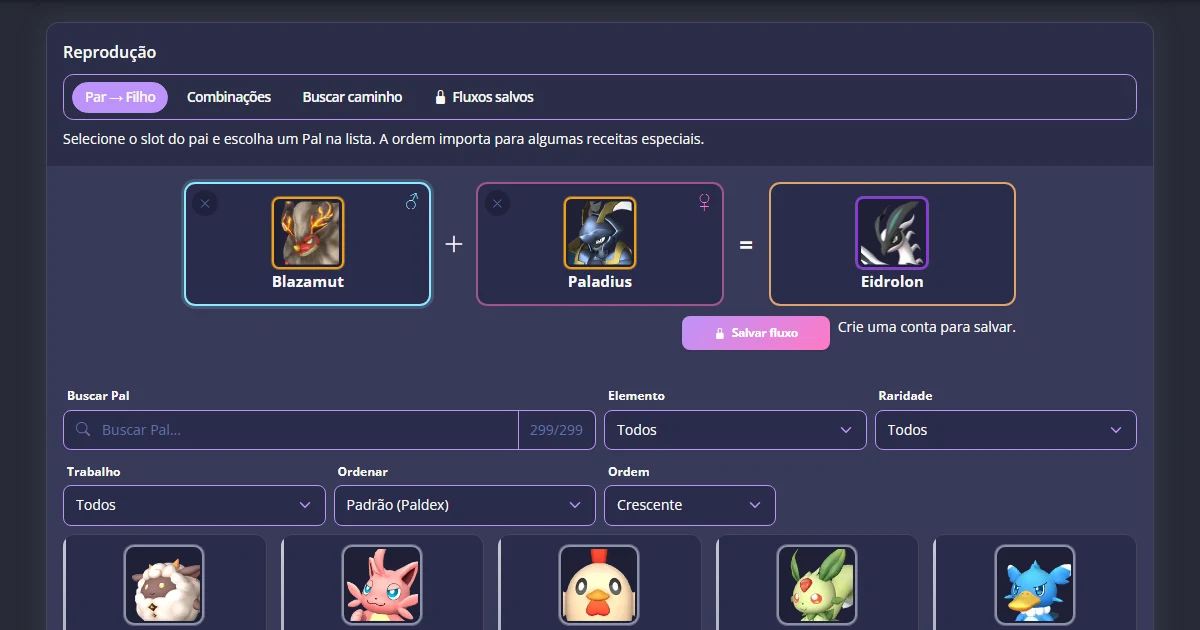
Why does Blazamut + Paladius give Eidrolon on one site and Renjishi on another? Because Palworld breeding follows an exact rule hidden in the game files, and almost nobody implements the detail that decides tied cases. This guide explains the whole rule with real numbers from version 1.0.5 and shows how to use it to your advantage.
Everything here was checked directly against Palworld’s data tables (CombiRank, CombiDuplicatePriority, IgnoreCombi and DT_PalCombiUnique), the same tables that power PalBoard’s breeding calculators.
The rule in one sentence
The child is the Pal whose breeding rank is closest to the average of the parents’ ranks, among the Pals that can be born through the formula. If two Pals are equally close, the one with the higher duplicate priority wins. Unique recipes override all of this.
Now, piece by piece.
1. Every Pal has a breeding rank
Every Pal has a number called CombiRank, ranging from 30 to 3080. The lower the number, the “stronger” the Pal is for breeding. Some examples:
Pal
Rank
Jetragon
70
Paladius
180
Renjishi
290
Eidrolon
300
Blazamut
410
Anubis
480
Relaxaurus
1090
Cattiva
2760
Daedream
2910
Lamball
3050
Chikipi
3080
Ranks are almost always spaced 10 apart (132 of the 182 gaps between consecutive Pals in the pool). Remember this: it is where ties come from.
2. The target is the average, rounded up
For two parents with ranks A and B, the game computes the target as:
target = floor((A + B + 1) / 2)
In practice it is the arithmetic mean with .5 rounded up. Example: Blazamut (410) + Paladius (180) → (410 + 180 + 1) / 2 = 295.5 → target 295.
3. Not every Pal can be born through the formula
Of the 299 Pals in 1.0.5, only 183 are in the formula pool. Excluded are:
- 114 Pals that only hatch from a unique recipe (nearly all variants, such as Fuack Ignis or Leezpunk Ignis, and legendaries like Jetragon and Orserk). If a Pal has its own recipe, the average never picks it.
-
39 Pals flagged
IgnoreCombi, which the game explicitly removes from the pool, such as Paladius.
This explains results that seem to “skip” Pals: between rank 30 and 230 there are almost no eligible candidates, because the legendaries are all recipe-only.
4. The tie-break: higher priority wins
Because ranks go up in steps of 10, half the time the target lands exactly between two Pals, 5 away from each. Of the 44,551 possible pairs, 13,981 end in a tie, almost a third.
In that case the game picks the Pal with the higher CombiDuplicatePriority. For nearly every Pal this value is the rank times 100, so in practice the tie goes to the higher-ranked Pal.
Back to the example: target 295, Renjishi (290) and Eidrolon (300) tied at distance 5. Priorities: Renjishi 29,000, Eidrolon 30,000. Eidrolon hatches. Sites showing Renjishi apply the tie-break backwards.
Two more classic examples that make good tests for any calculator:
- Lamball + Cattiva → target 2905 → Daedream (2910) and Tanzee (2900) tie → Daedream hatches.
- Lamball + Chikipi → target 3065 → Teafant (3070) and Vixy (3060) tie → Teafant hatches.
5. Unique recipes override the formula
There are 136 unique combinations in 1.0.5: specific pairs that always produce a specific child regardless of ranks. Some examples:
- Relaxaurus + Sparkit → Relaxaurus Lux
- Kitsun + Nyafia → Kitsun Noct
- Menasting + Knocklem → Menasting Terra
- Katress + Wixen → Wixen Noct, but Wixen + Katress → Katress Ignis. For some recipes the order (the sex) of the parents matters.
Anubis, contrary to popular belief, has no unique recipe: it hatches through the formula from any pair whose target is 480, such as Blazamut + Univolt Cryst.
On top of the recipes, two Pals of the same species always produce that species, variants included.
The full list is on PalBoard’s Combinations tab: pick the Pal you want and see every pair that produces it, with unique recipes marked.
6. Mutations and cakes don’t change the child
Since 1.0, a small share of eggs hatch mutated, with better stats and an exclusive passive, and special cakes raise that chance or passive inheritance. None of this changes which Pal hatches: the species is still decided by the rule above. Mutation and cakes affect the child’s quality, not its species.
Putting it to use
- Want a specific Pal? Use Combinations and pick the pair with parents you already own.
- Own a few Pals and want to reach another? Path finder builds the shortest breeding chain from what you have.
- Just want the child of one pair? Pair → Child answers instantly, with the correct tie-break.
All three tools use exactly the game’s data and the rule described here, and are updated with every patch.
Frequently asked questions
How does Palworld decide the child of two Pals?
By the average of the parents’ breeding ranks, rounded up. The eligible Pal with the closest rank hatches; on a tie, the one with the higher duplicate priority, which in practice is the higher-ranked Pal. Unique recipes take precedence.
Why do different sites give different children for the same pair?
Almost always because of the tie-break. The game favors the higher priority; many calculators favor the lower one and flip the result in about a third of all pairs.
How many unique recipes are there?
136 combinations of two different Pals in 1.0.5, plus the rule that two Pals of the same species produce that species.
Does the parents’ sex matter?
Not for the formula. For some unique recipes, yes: Katress and Wixen produce Wixen Noct or Katress Ignis depending on which is the father and which is the mother.
Does mutation change the child’s species?
No. Mutation and cakes change stats and passives; the species follows the rank rule.
Sources
- Palworld 1.0.5 data tables:
DT_PalMonsterParameter(CombiRank, CombiDuplicatePriority, IgnoreCombi) andDT_PalCombiUnique - PalCalc, the open-source calculator whose tie-break implementation was used as a cross-reference
- Palworld v1.0 — official patch notes — Pocketpair, Jul 10, 2026